


HESE Technology
HESE is a relatively new building technology. HESE uses tubular membranes to contain and compress local soils or regolith to
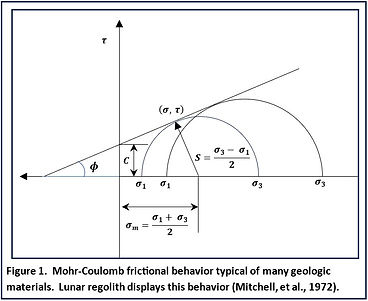
form strong beams and columns. HESE is an ultra-low logistics construction technology. Only the HESE membranes need to be transported to the installation site, with local soil or regolith used as fill. The phenomenon that makes HESE possible is the frictional Mohr-Coulomb behavior of HESE’s fill materials, coupled with the behavior of the HESE membranes.
Frictional Mohr-Coulomb materials exhibit increased shear strength with increased compressive hydrostatic stress (Coulomb, 1776; Mohr, 1900). Many common Earth soils, such as sands, gravels, and crushed rock, exhibit this behavior. These materials are abundant and widespread on Earth. They are believed to also be widespread and plentiful in lunar regolith and Martian regolith.
An example of frictional Mohr-Columb behavior is shown in Figure 1. The data are typically determined by a series of triaxial compression tests on cylindrical soil samples. The cylindrical sample is loaded hydrostatically until a target confining stress, , is reached. Axial loading, , is then added until a maximum axial stress is obtained. On the x-axis of the figure are plotted the values of the axial stress and the confining stress. The circles are called Mohr’s circles and have diameters equal to the difference between the confining stress and the maximum axial stress. The circles are centered on the x-axis at the average of these stresses. The x and y pairs on the line tangent to each of the circles represent the normal stress and shear stress, respectively. The y-axis is the soils’ shear stress capacity, . The soil’s cohesive strength, C, is the intrinsic, shear-resistant bond holding particles together independent of normal stress. As the hydrostatic stress increases, the shear capacity of the soil increases. For frictional materials, the shear strength of a soil is typically expressed as its internal friction angle, . For frictional Mohr-Coulomb materials, compressive hydrostatic stress causes the particles to be compressed
against each other and increases the friction between particles, resulting in increased shear strength and stiffness (Young’s modulus). From 2007-2009 a Research Team from the US Army Engineer Research and Development Center and the US Army Natick Soldier Center investigated whether strong beams and columns could be made by compressing a Mohr-Coulomb frictional soil fill inside tubular fabric membranes. Tensile stresses within the membranes would provide the compressive hydrostatic stress. The objective was the development of construction methods for austere Earth regions that have minimal construction materials. Using such construction methods, only the membranes would need transporting to the construction site, with local soils used as fill. This would greatly reduce the required Army logistics support for remote outposts.
The Army researchers performed a series of laboratory experiments in which a common sand was contained inside 4-
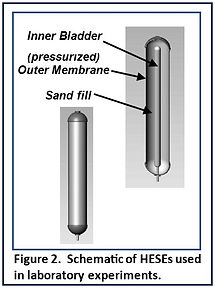
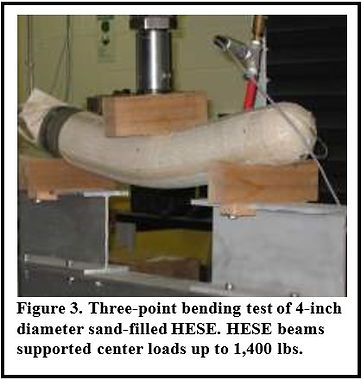
inch diameter tubular fabric membranes. The soils were subjected to hydrostatic stress by employing 1-inch diameter expanding air bladders centered in the structures (Figure 2). The bladders were pressurized to 100 psi (0.69 MPa), compressing the fill and creating tensile stresses in the membranes. The researchers anticipated this would increase the structures’ strengths and stiffnesses, but were surprised by the magnitude of the increases. For example, in 3-point bending experiments (see Figure 3), 4-inch diameter sand-filled beams supported center loads of up 1400 lb. across a free-span of 21 inches, with approximately linear response. And, for example (Figure 4), a 4-inch diameter, 28-inch long, sand-filled column supported an axial load of 5400 lb. before buckling, which was 12 times the axial stress capacity of an unpressurized fabric sand column (Ressler, 1979). The structures’ strengths and stiffnesses were the result of their internal hydrostatic stress inducing frictional Mohr-Coulomb response in their sand fills, as well as the fabric membrane response. The Army researchers termed these types of structures “Hydrostatically Enabled Structural Elements,” or HESEs. Their results were published in Doherty et al., 2009. The researchers were awarded a US Patent in 2012 (Welch, et al., 2012).
Lunar regolith has been studied extensively by NASA and others. The general consensus is that lunar regolith exhibits frictional Mohr-Coulomb behavior. For example, Mitchell, et al., (1972) concluded that lunar regolith has internal friction angles probably in the range of 30⁰ to 50⁰. Frictional Mohr-Coulomb type materials are also predicted to be part of Martian regolith (Oravec et al., 2025). Frictional Mohr-Coulomb materials are abundant and widespread on Earth. HESE beams and columns can be produced on the over much of the land masses on Earth, and on Moon and Mars, using local soils or regolith as fills, with only the membranes needing transport. HESEs are a very low logistic solution for building beams and columns on the Earth, Moon, and Mars.
The Army research program that led to the invention of HESE changed direction at about the time of the HESE patent, and HESE development stopped. Planet Z Tech is continuing HESE technology development for use on the Earth, Moon, and Mars. Planet Z has two patents pending associated with HESE design and fabrication methods. These patents augment the original HESE patent. We are teaming in the development program with both the Mississippi Polymer Institute of the University of Southern Mississippi, and the Mississippi State University Center for Advanced Vehicular Systems.

References
-
Coulomb, C. A. (1776). Essai sur une application des regles des maximis et minimis a quelquels problemesde statique relatifs, a la architecture. Mem. Acad. Roy. Div. Sav., vol. 7, pp. 343–387.
-
Doherty, R.M., Hynes, M.E., Hancock, S.D., Pittman, D.W (Editors), 2009. “Proceedings - Stabilization of Buildings Workshop.” Department of Homeland Security, Memphis, Tn. 25-
-
Mitchell et. al., 1972. “Mechanical Properties of Lunar Soil: Density, Porosity, Cohesion, and Angle of Internal Friction,” Proceedings of the Third Lunar Science Conference, Vol. 3, PP. 3235-3253, M.I.T. Press, 1972. https://articles.adsabs.harvard.edu/cgi-bin/nph-iarticle_query?1972LPSC....3.3235M&defaultprint=YES&filetype=.pdf
-
Mohr, O., 1900. “Welche Umstände bedingen die Elastizitätsgrenze und den Bruch eines Materials Civilingenieur.”
-
Oravec, H.A., Asnani, V. M., Creager, C.M., Moreland, S.J., 2025. “Geotechnical Review of Existing Mars Soil Simulants for Surface Mobility,” https://ntrs.nasa.gov/api/citations/20200003046/downloads/20200003046.pdf
-
Ressler, S.J., 1979. “Response of a Tubular Sandbag to Thrust and Moment Loading,” Miscellaneous Paper SL-79-9, US Army Engineer Waterways Experiment Station. Vicksburg, MS.
-
Welch, C.R., Abraham, K., Ebeling, R.M., Quigley, C., Buehler, K., 2012. “Hydrostatically Enabled Structural Element.” U.S. Patent #8,209,911, issued 3 July 2012.